
The Newsletter Returns!

In this newsletter
Hello
Latest Blog Post
Ramses and the Pharaohs’ Gold Exhibition
Hello
A long-overdue hello to all of you lovely subscribers. I am terribly sorry it has taken so long into this year to finally speak to you all again, but finishing off my fourth book took a little longer than expected, and my brain somewhat went to sleep afterwards! I am so excited to be back chatting with you now, though, and to sharing more about the book closer to its release towards the end of this year.
Latest Blog Post
Last week I was able to get the first blog post of the year up, which was a really interesting interview with filmmaker Leon Mitchell. Leon has been working on a dual documentary and fiction novel about Empress Matilda, daughter and heir of Henry I of England. Matilda should have become England’s first queen regnant, but was challenged for her throne by her cousin Stephen, leading to a lengthy civil war known as The Anarchy, which we have discussed on the blog before. She is a truly fascinating character who deserves more public attention, and so it was great to pick Leon’s brains about how he approached her, and what story he wanted to tell. If you haven’t seen it, make sure to have a read here.

Ramses and the Pharaohs’ Gold Exhibition
I recently visited the Ramses and the Pharaohs’ Gold exhibition at Battersea Power Station in London. The exhibition includes 180 artefacts loaned from the Egyptian Museum Cairo, and centres on the life and reign of Ramses II, pharaoh from 1303 BC – 1213 BC. Ramses is considered one of the most powerful, successful and famous Ancient Egyptian rulers, and there is certainly lots to unpack of his nearly 67-year reign.
I must start on a negative, but bear with me. The tickets are sold by half-hour time slots, and so we arrived promptly about 10-15 minutes before our time. Security is high, with bag searches and body scanning in effect, but we were very near the start of the queue and so got inside swiftly. To begin, you enter a room with a large screen, and over the minutes people slowly gathered, waiting for what was evidently to be an introductory video. Here was where the problem started: they made us wait for what appeared to be every single person in the line to enter the room before starting the video. Considering every person had to go through security, then also climb up a set of stairs, and had the opportunity to have a tourist photo taken, this meant that we were waiting in the room until 15 minutes into our time slot. At this point, we had been standing around for half an hour in total.
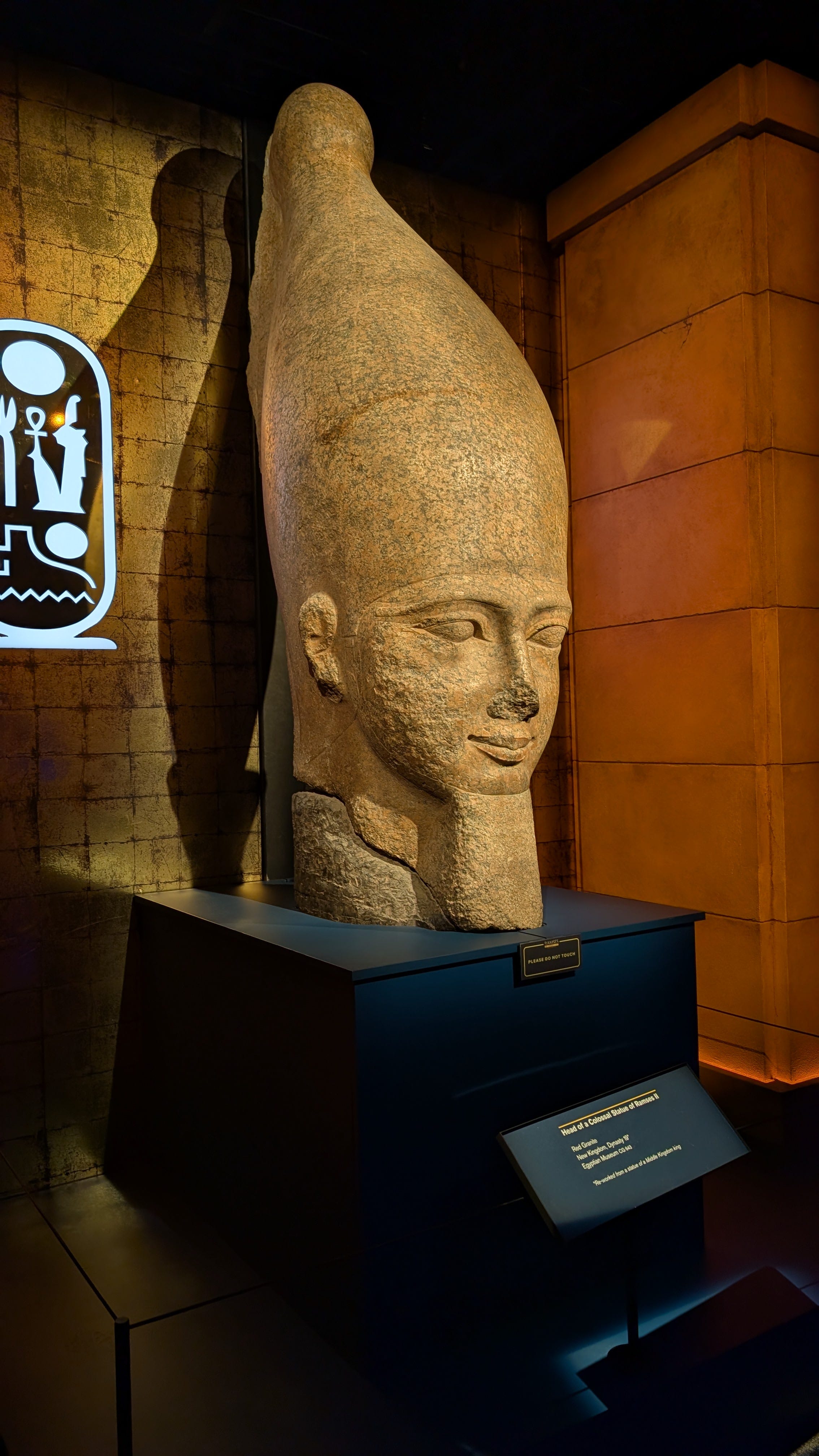
The video was a decent little introduction to Ramses’ reign, why he was important, and some of the key themes the exhibition would explore, but it lasted only around 4-5 minutes. Then, the doors to the exhibition opened and everybody had to funnel through into the exhibition, where you were met by a single huge statue head of Ramses. This artificially created a huge bottleneck, where we then had to queue for many more minutes for all of the people in the room (I would estimate up to 100 people) to get through the door, see the statue, and pass into the exhibition room; it also meant you had to queue to see any case in the first room of the exhibition, as everyone was huddled together. It was only from the second room onwards that the crowd thinned as people took different lengths of time, and you could actually enjoy the exhibition.
This seems like a huge oversight on behalf of the organisers. If they instead just ran the movie several times throughout the time slot, then those first in could have viewed the movie and entered the exhibition and began looking whilst the next lot watched the movie, and thus this bottleneck would be avoided, and it would also stop those at the front of the queue waiting for quite such a long period of time.
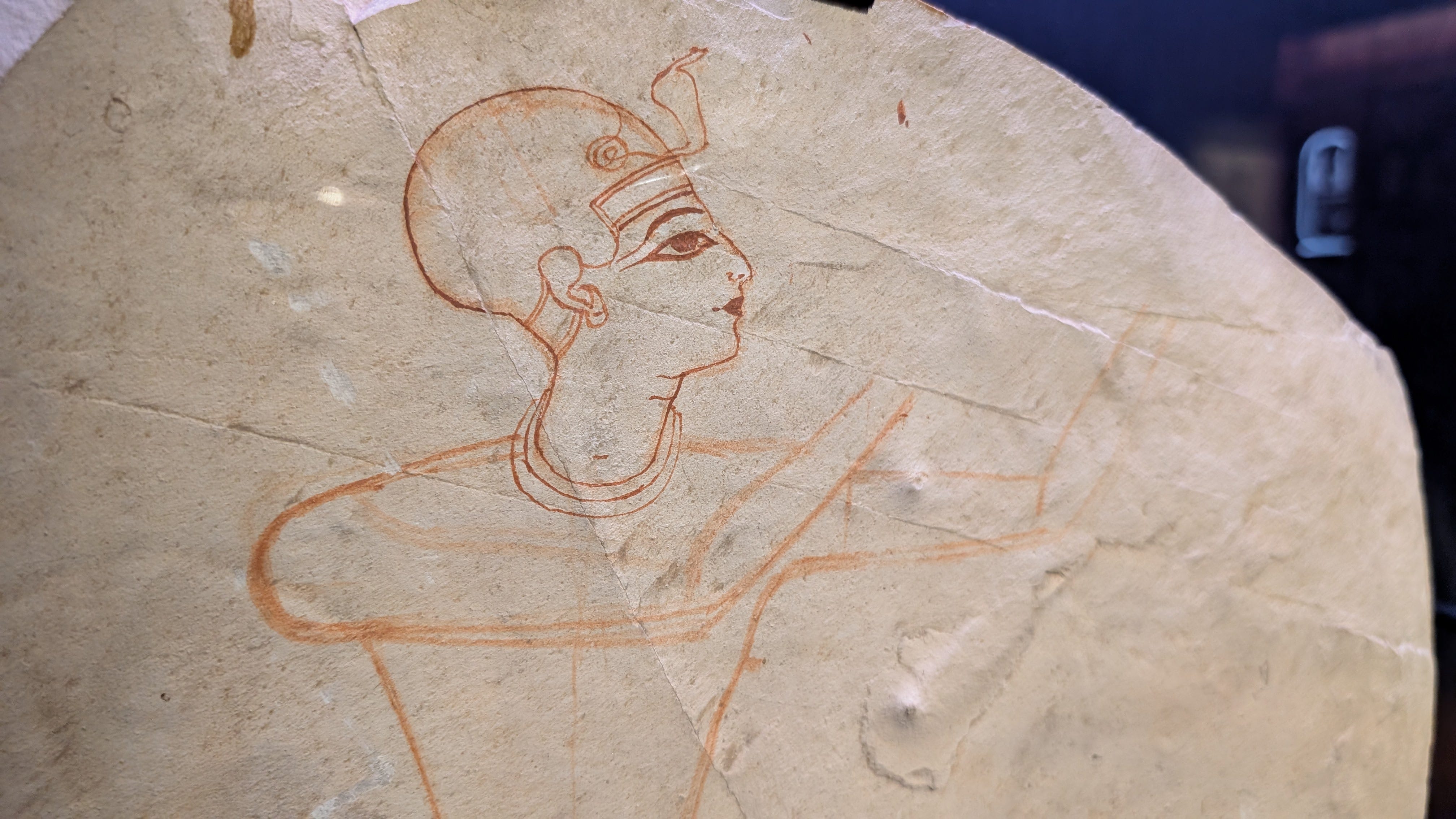
Regardless of this poor start, the rest of the exhibition was very well done. There was a big variety of objects, and they were well spread to allow maximum viewing: some were in the walls, some in free-standing cases, and there were multiple statues dotted around the middle of the room to allow good flow. Exhibition signage was clear and informative without overfacing visitors with walls of text, and many cases had wonderful videos running above them which gave an in-depth look at a particular item within the case, providing close-up shots and further context, which I really appreciated. There were other screens throughout the exhibition, some showing interviews with historians and archaeologists about dig sites or events of the reign, others showing video footage of Ancient Egyptian ruins, which transformed into digital recreations of the sites in their hey-day. There were also a few models of some of the sites.
The only criticism I have of the setup, as a history buff, is that none of the artefacts had dates written on their labels – instead, everything was labelled with which dynasty it came from. As someone unfamiliar with Ancient Egypt, I found this very frustrating to be unable to place the era or timescale of the artefacts I was viewing, including how close in time they were or were not to Ramses.
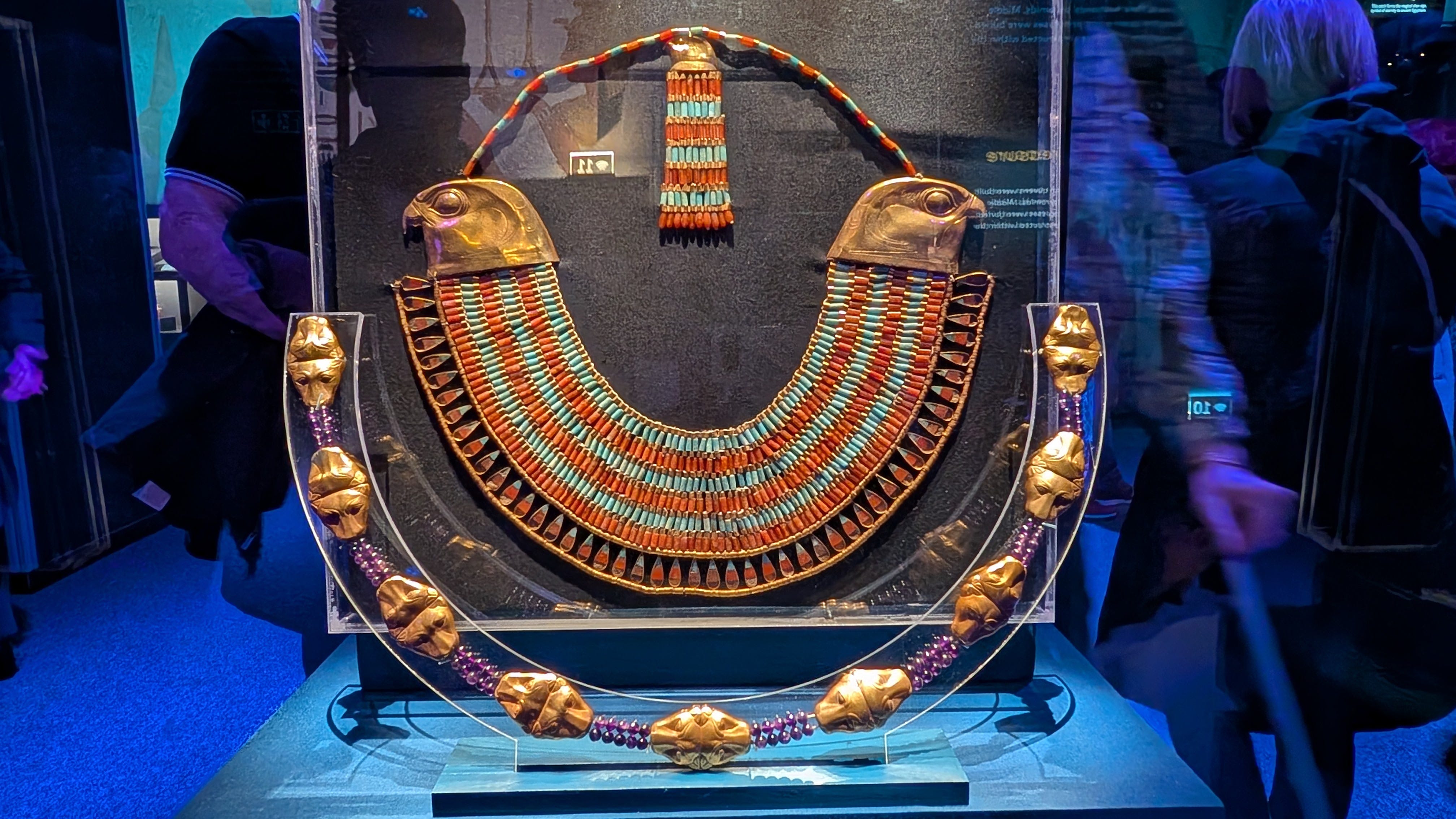
Many, if not most, of the artefacts in the exhibition did not directly relate to Ramses, but instead were used to fill in information about politics, culture, religion, and other aspects of society that would have been familiar to him. For me, this was not a big issue; I learnt snippets of Ramses’ life throughout the exhibition through the signage and films, and I enjoyed simply seeing the breathtaking items on display. Others, though, may be disappointed by this, considering Ramses is the leading name of the exhibition – the person I visited the exhibition with, for example, said that they felt the title of the exhibition was misleading, as there was not much of Ramses, nor of gold.
There is certainly plenty to see. The website suggests a typical visit takes 60 to 75 minutes. Not counting the long wait for the introductory film, I spent almost exactly 90 minutes in the exhibition, though I looked at every artefact, read every sign, and watched every video (surprised, anyone?). This estimate is probably therefore pretty fair for the average attendee, and keenos like me would know they were likely to take longer in any case. There is also a VR experience at the end through the shop, which we did not partake in, though may interest others. Tickets are a little over £20 for adults, and group and family options are available. Considering the price of many London exhibitions, and the treasures within – which you would otherwise have to travel to Cairo to see – I think this is a reasonable price, though understand this will be expensive for many (a family bundle for 2 adults and 2 children with 2 audio guides comes to over £100, for example).
Despite my complaints, then, I would still definitely recommend seeing this exhibition, if for no other reason than as I mentioned it is a rare chance to see these items in England. The artefacts are astounding, the research is thorough, and the exhibition is clearly well thought-out. The exhibition lasts until the end of the year, so there is plenty of time to see it.
With that lengthy review, I shall sign off with a promise that I hope to return to monthly newsletters and blog posts, as we managed last year. There is certainly plenty brimming in my mind. Thank you for sticking by as I poured everything into my new book, and hope you will all see it was worth it when it is out!

Support me:
Follow me on Bluesky, or check out my blog.
You can also find my books on Amazon or in most bookshops!